
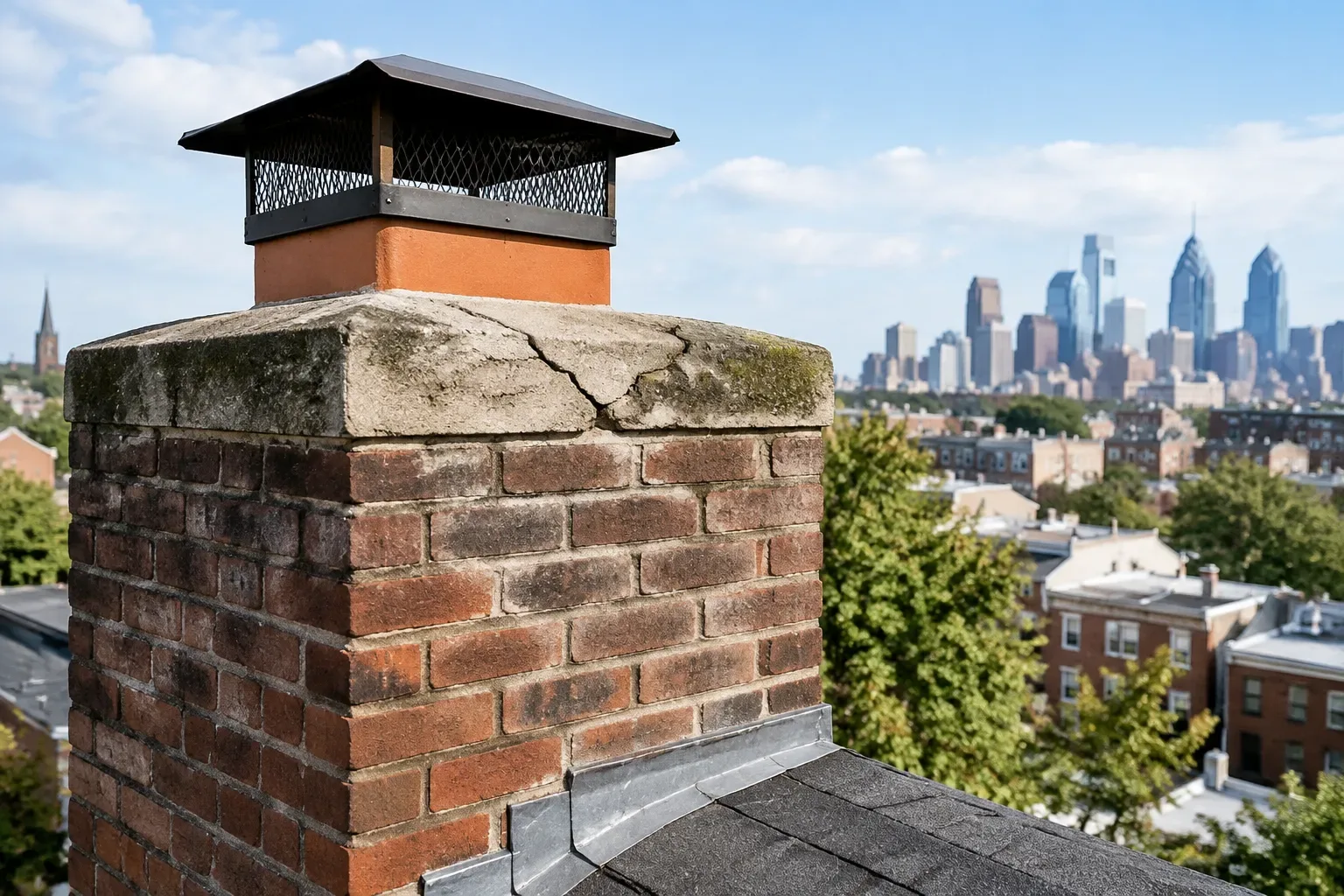
Why Is Water Staining Around My Fireplace on Washington Ln?
Water staining around a fireplace usually means moisture is entering somewhere above or beside the visible stain, not necessarily through the firebox itself. Possible sources include damaged chimney flashing, a cracked crown, missing or damaged cap components, worn masonry joints, roof defects, or nearby plumbing and HVAC penetrations. Water can travel along framing or inside a chimney enclosure before it becomes visible on a wall, ceiling, mantel, or surround.
For a home near Washington Ln, track whether the mark appears after rain, wind-driven storms, snow melt, or fireplace use. That timing helps narrow the investigation, but only an inspection can confirm the entry point. Tiptop maintenance can be a starting point for readers seeking chimney-related guidance in Philadelphia.
Quick Answer
A stain around the fireplace is a symptom, not proof of one specific problem. If it gets darker after rain or snow melt, the chimney exterior, roof covering, flashing, crown, cap, or masonry should be evaluated. If it occurs only while the fireplace runs, condensation, venting, or appliance-related issues may need attention instead.
Do not paint over the stain or caulk the interior surface as the primary fix. Those steps can hide evidence while the building materials behind the wall remain wet.
What can cause water to show up around a fireplace?
The mark you see indoors may be some distance from the actual opening. In Philadelphia, recurring rain, wind-driven precipitation, freezing, and thawing can expose small weaknesses in masonry and roof-to-chimney transitions. Water absorbed into porous brick or a hairline crack can freeze and expand, worsening mortar loss, spalling, or crown damage over time.
| Possible source | Clues a resident may notice | What an inspection needs to confirm | Likely next step |
|---|---|---|---|
| Chimney crown damage | Stain worsens after rain; cracked or worn concrete may be visible from the ground | Cracks, failed slope, separation, and water paths at the top of the stack | Crown repair or replacement if the crown is the entry point |
| Cap or flue opening issue | Dampness in the firebox, rust, debris, or water after storms | Cap condition, flue opening protection, and whether water is entering the flue | Repair or replace the affected cap component |
| Failed flashing | Ceiling or wall staining close to the chimney, often after wind-driven rain | Step flashing, counterflashing, roof intersections, and nearby roof materials | Chimney or roofing repair, depending on the failed component |
| Masonry or mortar deterioration | Damp brick, flaking faces, open joints, or recurring interior marks | Brick condition, mortar joints, absorption, and cracks | Masonry repair and an appropriate moisture-management approach |
| Roof, plumbing, or HVAC issue | Stain is offset from the chimney or occurs without rain | Roof covering, penetrations, supply or drain lines, and mechanical equipment | Referral to the appropriate trade if the chimney is not the source |
Older masonry and attached-home construction can create several possible water paths. Roof-to-wall transitions, neighboring building elements, multiple roof slopes, valleys, and chimney crickets can all allow water to travel before it appears indoors. A visible stain around the fireplace therefore does not prove that the chimney itself is leaking.
Does the timing of the stain point to the source?
Timing is one of the most useful clues you can provide, although it does not replace an exterior evaluation.
After rain or wind-driven storms
This pattern points toward the exterior envelope, such as flashing, roof covering, cap, crown, or masonry.
After snow melt or freeze-thaw weather
Water may be entering cracks or porous materials that expanded during freezing conditions.
Only while using the fireplace
This calls for evaluation of the fireplace, flue, venting, or condensation rather than an automatic assumption of a roof leak.
With no weather pattern at all
Nearby plumbing, HVAC condensate, or another interior source should remain on the list of possibilities.
How can you tell if the chimney or roof is responsible?
Start by separating what you observe from what a professional can verify. An observable symptom is a darkened patch, peeling paint, damp masonry, or a musty odor. A possible cause is failed flashing or a crown crack. A professional finding is the confirmation of a specific failed joint, roof detail, masonry defect, or water path.
A chimney specialist should examine the cap and crown downward, then review masonry joints, the flue area, flashing, roof intersections, and interior staining patterns. The Chimney Safety Institute of America explains that a chimney inspection evaluates the condition of the chimney and venting system, including issues that routine use may not reveal.
If the issue is severe, such as active storm-related leakage or unstable-looking masonry, review the available 24/7 chimney emergency service information. For a non-emergency stain, the goal is a careful diagnosis, not a rushed sealant application.
What should you do before an inspection?
You do not need to climb onto the roof or chimney. Roof access without appropriate equipment and training creates a fall hazard, and close-up inspection can disturb damaged materials.
- Photograph the stain from several angles and note its location relative to the firebox, mantel, ceiling, and exterior chimney wall.
- Write down when it first appeared and whether it changes after rain, wind, snow melt, or fireplace use.
- Check from indoors for active dripping, rust, damp firebox materials, peeling paint, odors, or ceiling softness. Do not probe a sagging ceiling.
- Move valuables away from the area and place a container under active drips if it is safe to do so.
- Arrange an inspection that considers both chimney components and nearby roof details. If those are sound, ask which other trade should evaluate the area.
Keep the fireplace out of use if moisture is entering the firebox, if a gas appliance is affected, or if there is any concern about electrical components nearby. The National Fire Protection Association's NFPA 211 framework for chimneys, fireplaces, vents, and solid-fuel appliances is one reason a potentially affected venting system deserves more than a cosmetic interior repair.
Why paint, interior caulk, and cleaning do not solve the leak
Paint can improve appearance only after the source is corrected and affected materials have dried appropriately. Interior caulk may divert a small amount of water temporarily, but it can also trap moisture or conceal the route an inspector needs to see.
Chimney cleaning is also different from leak diagnosis. Removing soot or debris can be part of fireplace maintenance, but it does not repair failed flashing, open mortar joints, damaged masonry, or a cracked crown. Readers looking for broader service information can review the site's chimney service details, but a recurring stain should be described specifically as a moisture problem when requesting help.
Persistent water intrusion can support mold growth, so it should be corrected rather than simply covered. The EPA advises addressing moisture problems promptly in its guidance on mold and health.
When might you need a roofer, mason, or another trade?
Not every fireplace-area stain belongs to one trade. A chimney professional may identify a damaged crown, cap, masonry joint, or chimney-related flashing condition. A qualified roofer may be the better fit when the roof covering, valley, cricket, or non-chimney penetration is failing. A masonry contractor may be needed when brickwork or mortar requires more extensive repair.
If the staining occurs without rain and does not correlate with fireplace use, plumbing or HVAC should also be considered. For example, ductwork alone does not normally create a water stain, but a condensate issue or a nearby mechanical component can. If you are considering whether ventilation-system service is relevant to an indoor-air concern, see air duct cleaning in Philadelphia, while keeping the water-source investigation separate.
The common mistake is assuming that the most visible feature, the fireplace, must be the failed component. A good diagnosis follows the moisture path instead.
What is the practical next step for a recurring stain?
Document the pattern, protect the room from active drips, and seek an inspection that distinguishes chimney defects from roof and interior-system defects. The most useful result is not simply a recommendation for coating or cleaning. It is a clear explanation of where water is entering, what materials are affected, and which repair will stop the source.
For a water stain that keeps returning, contact Tiptop maintenance to discuss a chimney-related inspection in Philadelphia and describe the weather pattern, stain location, and any active moisture you have observed.
Ready to discuss your project?
For a recurring fireplace-area water stain in Philadelphia, reach out to discuss an inspection and the moisture pattern you have noticed.
FAQ
Can a chimney leak cause a stain on a wall beside the fireplace?
Yes. Water can enter at the chimney top, flashing, masonry, or a nearby roof detail and then travel along framing or inside the chimney enclosure. That means a stain beside the fireplace may be below or away from the actual entry point. The path should be inspected from the exterior downward rather than judged from the stain location alone.
Why does the stain get worse after heavy rain?
A darker or larger stain after rain suggests that water may be entering through the exterior building envelope. Wind can push rain against caps, crowns, exposed masonry, flashing, and roof intersections. It does not identify the exact defect by itself, but it is useful evidence for an inspector because it helps separate rain-driven intrusion from plumbing or appliance-related moisture.
Is it safe to use my fireplace if there is water in or around it?
Avoid using it until the situation is assessed if water is inside the firebox, near a gas appliance, close to electrical components, or associated with visible damage. Moisture can affect fireplace materials and may signal a venting-system issue. The safest next action depends on the appliance type and what is wet, so explain those details when arranging an evaluation.
Could a cracked chimney crown cause an indoor water stain?
It could. The crown is the top surface that sheds water away from the chimney structure. Cracks, poor slope, or deterioration can allow water into the chimney system or masonry below. Freeze-thaw exposure can enlarge small defects once water gets inside. The crown still needs close inspection because flashing or masonry may be the real source instead.
Does chimney cleaning stop water leaks?
No. Cleaning can remove soot and debris, but it does not repair a crown, cap, flashing, roof intersection, or deteriorated mortar. If cleaning is also due, it can be planned separately after the moisture issue is understood. For related maintenance questions, see this guide on signs a chimney needs cleaning.
Could air ducts be causing the stain near my fireplace?
Duct cleaning itself is not a remedy for water staining. However, a condensate line, HVAC component, or nearby mechanical penetration can sometimes be a separate moisture source. If an inspection does not find a chimney or roof path, it may make sense to involve an HVAC or plumbing professional. For a separate decision about service, read whether air duct cleaning is necessary.
How do I know if the problem is flashing or masonry?
You generally cannot confirm that from indoors. Flashing failures often show up after rain near the roof-to-chimney intersection, while masonry problems may involve open mortar joints, cracked brick, spalling, or moisture absorption. Both can create similar indoor stains. An exterior review of the roof detail and chimney condition is needed before choosing a repair.
Will the stain go away after the leak is fixed?
The moisture source must be corrected first, and affected materials need time to dry. Some stains may remain and require cosmetic repair afterward, especially on painted drywall or ceilings. If materials are soft, damaged, or show persistent mold-like growth, further evaluation may be needed before repainting. Do not assume a dry-looking surface means the area behind it is dry.
What should I tell the inspector about the stain?
Share when it began, whether it changes after storms or fireplace use, where it appears, and whether there has been active dripping. Photos taken over time are especially useful. Also mention any roof work, chimney work, plumbing changes, or HVAC work completed near the area, without assuming that prior work caused the problem.